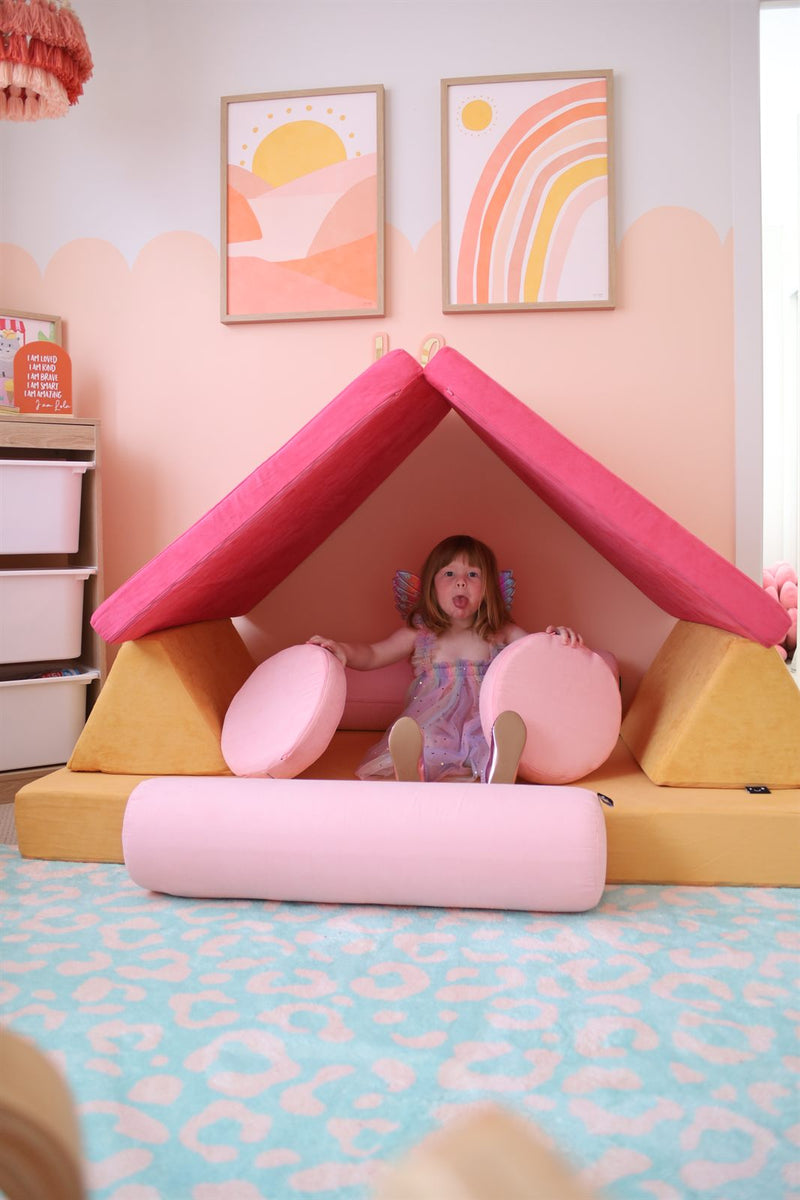

Without turning this blog into a history lesson or psychology lecture, we’re here to give you everything there is to know about cognitive development in children, before we dive into the more fun stuff. (Like cognitive play with your Funsquare modular play sofa!)
What is the theory of cognitive development?
The theory was developed by Jean Piaget in the 1920s when, while working with children, he noticed they often lacked the ability of logical thinking. This suggested that the way kids think is vastly different to the way adults think and that they build up knowledge and develop cognitive skills as they grow.
It’s all pretty intuitive but when you understand the different childhood developmental phases you can support your child’s learning along the way.
Stages of cognitive development
The theory of cognitive development suggests children experience four stages of development.
Children go through each stage in the same order and the level of development is determined by both biological age and interaction with the environment.
The four stages
- The Sensorimotor Stage (birth to 18-24 months)
- The Preoperation Stage (2 to 7 years old)
- The Concrete Operational Stage (7 to 11 years old)
- The Formal Operational Stage (adolescence to adulthood)
The Sensorimotor Stage (birth to 18-24 months)
During this stage, your bub is very much living in the now. They’re yet to develop the ability to store memories and have no sense of permanence.
This is why, when you play peekaboo with your little one, they won’t look around for you. They simply can’t think about something that doesn’t exist right in front of them.
The main ability to be developed at this stage is object permanence: knowing that an object still exists, even if it’s hidden. To do this, they need to develop the ability to form mental pictures. Then, they’ll begin to be able to store information, recall it and label it.
Their development will appear in play when they can start to use one object to represent another (a block as a truck) and they begin using language because they recognise words can represent objects and feelings.
How to support development during the sensorimotor stage?
- Peekaboo and hide-and-seek games
- Tactile play with play dough, finger paint, water or foam
- Bouncing balls and rolling around for motor coordination
- Talk to them, a lot
- Provide different textures, shapes and colours
The Preoperation Stage (2 to 7 years old)
During this stage, your child’s thinking is still intuitive, subjective and egocentric (based on their own view of the world).
It’s here that they’ll develop the ability to internally represent the world through language and mental imagery. They’ll be able to think about things symbolically, making a word or an object stand for something other than itself.
You might notice your little one demonstrating animism by thinking objects are alive and have feelings.
They’re not yet capable of logical problem solving. Their thinking is around how the world looks rather than how it is.
How to support development during the preoperation stage?
- Role play with dress-ups
- Play with things that can change shape (play dough)
- Letter-shaped magnets
- Blindfold your child and get them to guess something based on smell or taste
- Transform a corner of your home into a make believe world
The Concrete Operational Stage (7 to 11 years old)
This is when they’ll develop the ability to think logically. It’s a major turning point in cognitive development because they’ll now be able to work things out in their head.
Your child will begin to understand the concept of conversation and understand that things can change in appearance while its properties can stay the same.
They’ll also become less egocentric and begin to develop empathy.
But all this isn’t to say they won’t tend to make mistakes or get overwhelmed when asked to reason about abstract or hypothetical problems.
How to support development during the concrete operational stage?
- Build with blocks
- Bake cookies
- Tell tales
- Play in the tub
The Formal Operational Stage (adolescence to adulthood)
They’re all grown up! Now, they can follow a logical argument without reference to its content. They’ll develop the ability to think abstractly and logically test hypotheses.
Formal operational thought is free from physical constraints and can be carried out as ideas.
This is when things become easier, problem solving is less effortful and abstract ideas flow freely.
How to support development during the formal operational stage?
- Offer step-by-step explanations of concepts
- Uses charts and visuals aids during learning
- Explore hypothetical situations
There you have it, the four stages of cognitive development broken down with tips on how you can support growth.
Oh, and if you’re looking for some handy multifunctional furniture to support motor coordination, games of make believe, building and tactile play, check out our Play Sofa ;)