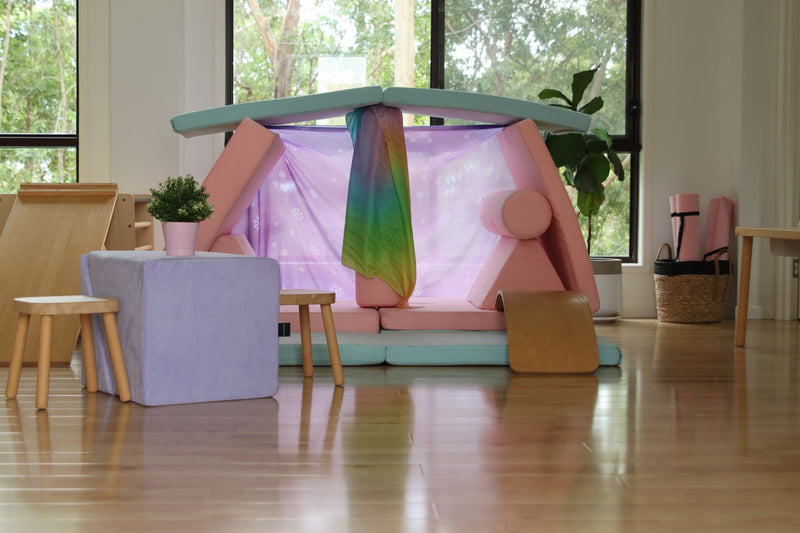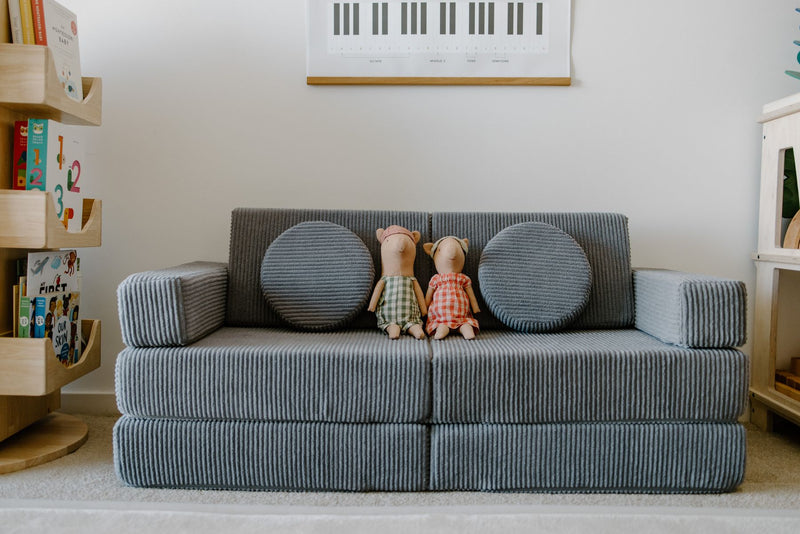

A modular play couch is one of the most versatile sensory-play tools you can have at home, because the same few foam pieces let a child seek movement and deep pressure when they need to release energy, then retreat into a soft, calming space when they need to settle. It supports the body's sensory systems through active building, climbing and crashing, and through quiet, enclosed "calm-down" setups.
This is a parent's guide to what sensory play actually is, how a play couch supports it, and the specific setups you can build at home. A quick, honest note up front: a play couch is a supportive play tool, not a medical device, and if your child has specific sensory or developmental needs, an occupational therapist (OT) is the right person to guide what helps them most.
What is sensory play?
Sensory play is any play that engages a child's senses and helps them make sense of the world. Most people think of the five senses, but two more matter enormously for how children regulate and move:
- Proprioception: the sense of where your body is in space, fed by deep pressure and "heavy work" like pushing, carrying, climbing and crashing.
- The vestibular sense: balance and movement, fed by rocking, rolling, sliding and tipping.
Every child has a sensory profile. Some are sensory seekers who crave movement and pressure; others are easily overwhelmed and need a calm retreat. Good sensory play gives a child both options, on their terms.
How a play couch supports sensory play
A traditional toy does one thing. A modular play couch flexes to whatever a child's nervous system is asking for that day, which is exactly what makes it such a useful sensory tool:
- For movement and energy: stacking and dragging the foam pieces is heavy work, and building slides, climbing towers and tunnels delivers vestibular and proprioceptive input in a safe, soft way.
- For deep pressure and calm: the same pieces become an enclosed cubby, a reading nook, or a soft landing space where a child can crash, burrow and settle.
- For texture: the smooth microsuede and the ribbed corduroy give two different tactile experiences against the skin.
Because it's all soft, GECA-certified Australian foam, the worst case during high-energy play is usually a giggle and a rebuild. You can read how it's all made on our guide to what a play couch is made of.
The sensory benefits, by type
Proprioceptive input (deep pressure and heavy work)
Lifting and carrying the bases, climbing up a build, and crashing down onto a soft surface all provide the deep-pressure, heavy-work input that many children find grounding and organising. A Funsquare Crash Pad (a generous 120cm × 120cm of soft, crumbed foam) is purpose-built as a deep-pressure landing and burrowing spot.
Vestibular input (movement and balance)
Sliding down a propped Thin Base, balancing along a bridge, rocking and rolling across a soft floor: these movement experiences help build balance, coordination and body awareness.
Tactile and calming input
Soft fabrics, an enclosed cubby, and a predictable "landing spot" all help with tactile comfort and emotional regulation. A consistent calm-down space gives a child somewhere to go when the world feels too loud.
5 sensory play setups you can build at home
- The Calm-Down Corner: roll out a Funsquare Cloud Mat as a soft floor and place a Crash Pad on top. A child can step on, lie back, and feel grounded in a dedicated low-sensory zone.
- The Reading Hideaway: build a simple A-frame cubby (two Trapeziums with the Thin Base draped over as a roof), tuck a Chill Pad inside as a seat, and drape a Fun Scarf across the entrance for a cosy, enclosed retreat.
- The Deep-Pressure Retreat: pair the play couch with a Funsquare Cloud Pod, whose soft, enveloping fabric is made for the deep-pressure comfort that sensory-seeking kids crave.
- The Crash-and-Climb Circuit: stack the bases into a low climbing tower, prop a slope off the front, and put the Crash Pad at the base as a soft landing. Great for releasing energy safely.
- The Soft Floor: lay everything flat into Bed Mode (a continuous 80cm × 240cm surface) for rolling, stretching and floor play.
For step-by-step build instructions and more ideas, see our full guide to what you can build with a play couch.
Sensory play for children with additional needs
For children with autism, ADHD or sensory processing differences, a dedicated space to crash, burrow and apply deep pressure can help with regulation, focus and winding down. A play couch makes it easy to create that space at home, and to change it as your child's needs change from day to day.
We want to be careful and honest here: Funsquare products are designed to be soft, sturdy and safe, but they are not a medical device and we don't make therapeutic claims about individual children. If your child has specific needs, your OT is the best guide to what will actually help, and they can recommend how a modular couch or crash pad fits into a sensory plan.
Why a play couch works well as a home sensory tool
- Soft and safe for climbing, crashing and active input.
- Genuinely modular, so it adapts to seeking days and calming days.
- Washable: covers zip off for a cold machine wash, which matters for messy, real-life sensory play. See our cleaning guide.
- Durable: built to withstand the high-energy use typical of sensory and therapeutic settings.
- It grows with your child, so it keeps earning its place for years.
The best Funsquare pieces for sensory play
The play couch is the flexible core, and a few companions are especially popular for sensory setups: the Crash Pad for deep-pressure landings, the Cloud Mat for a soft foundation, the Cloud Pod for an enveloping retreat, and the Chill Pad as a child-sized companion seat. You can see the full sensory range on our Sensory Play page.
Sensory play and the NDIS
Calming and sensory setups are exactly the kind of developmental use Funsquare supports through our NDIS registration. We've been a registered NDIS provider since 2022 (Provider Number 4-G24F7MO, Group 0112, Assistive Equipment for Recreation), and Crash Pads in particular are commonly recommended by OTs and funded under low-cost Assistive Technology budgets. Whether an item suits a participant's plan is an individual decision, but we can supply the documentation your plan manager needs. For the full process, read our complete NDIS play couch guide or the eligibility overview on buying a play couch on the NDIS.
Sensory play FAQs
What is the best play couch setup for a calm-down corner?
Roll out a Cloud Mat as a soft base and place a Crash Pad on top, ideally tucked into a quiet corner. Add a draped Fun Scarf overhead for visual softness. This gives a child a dedicated, low-sensory space to step into, lie back, and feel grounded.
Is a play couch good for children with autism or ADHD?
Many families and OTs use modular foam pieces to create safe spaces for movement, deep pressure and regulation, which can support children with autism, ADHD or sensory processing differences. That said, a play couch is a supportive play tool, not a medical device, and your OT is the right person to advise what suits your child specifically.
What is deep pressure and how does a play couch provide it?
Deep pressure is firm, calming input to the body, like a big hug or the weight of a heavy blanket. A play couch provides it through crashing onto a soft Crash Pad, burrowing between cushions, and the heavy work of lifting and stacking the foam pieces.
Which Funsquare product is best for sensory needs?
It depends on the need. The Crash Pad is the go-to for deep pressure and safe landings, the Cloud Pod for an enveloping retreat, and the play couch itself for versatile active-and-calm play. Many families combine a play couch with a Crash Pad and Cloud Mat to cover both seeking and calming.
Is sensory play only for children with sensory needs?
No. All children benefit from sensory play. It supports gross motor development, balance, body awareness and emotional regulation. A play couch simply makes it easy and safe to offer that play at home for any child.
Can sensory equipment be funded through the NDIS?
Sometimes, when it's reasonable and necessary for a participant's goals. Crash Pads are commonly recommended by OTs and funded under low-cost Assistive Technology. Funsquare is a registered NDIS provider and can supply the documentation, but the funding decision rests with the NDIA, your plan manager and your OT. See our complete NDIS guide.
Build a sensory space your child will love
Whether your child seeks movement or needs a calm retreat, a Funsquare setup adapts to them. Explore the Sensory Play range, start with the Funsquare Play Couch, or add a Crash Pad for deep-pressure play.
Not sure what suits your child? A real person on our Melbourne team is happy to talk it through. Email hello@funsquare.com.au or call 0468 018 005.